As the warehousing industry faces mounting pressure to increase speed, expand capacity, and reduce costs, selecting the right automation system has become more important than ever.
The Modula Lift vertical lift module (VLM) is one of the most widely used automated storage and retrieval systems across manufacturing, retail, healthcare, e-commerce, and more. By optimizing space, improving accuracy, and enhancing productivity, it has become a key component of modern warehouse operations.
The Modula Flexibox, on the other hand, is a high-performance bin-based configuration built on the Modula Lift platform. It is designed specifically for high-frequency, small-item, high-throughput picking. Flexibox is not a replacement for the Lift; rather, it complements it by providing a targeted solution for scenarios where speed and throughput are critical.
In this article, we will analyze the core differences between the two systems—from flexibility and workflow to ideal application scenarios—to help you determine the most suitable solution for your warehouse.
1.Shared Advantages of Modula Lift and Modula Flexibox
Both Modula Lift and Modula Flexibox deliver significant value to modern warehouse operations:
Scalability and System Integration
Both systems can be scaled as needed and integrate seamlessly with AMRs, conveyors, and other warehouse technologies.
Space Optimization and High-Density Storage
By fully utilizing vertical space, both systems significantly increase storage density, making them ideal for facilities with limited floorspace and large SKU counts.
Improved Picking Accuracy Through Automation
Automated retrieval and inventory control help reduce manual errors and improve order accuracy.
Enhanced Safety for Stored Items
Their enclosed structure helps prevent damage, loss, and unauthorized access, ensuring safer and more reliable inventory management.
Ergonomics and Ease of Use
Both systems offer intuitive interfaces and ergonomic picking heights, reducing operator fatigue and simplifying training.
Real-Time Inventory Visibility with WMS Integration
Both can connect to Modula WMS or third-party WMS platforms to enable real-time inventory visibility and workflow coordination.
2.How the Modula Lift Works

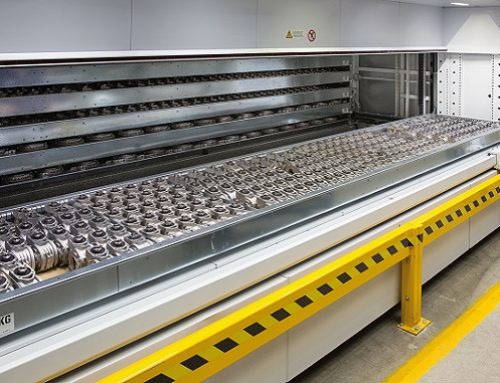
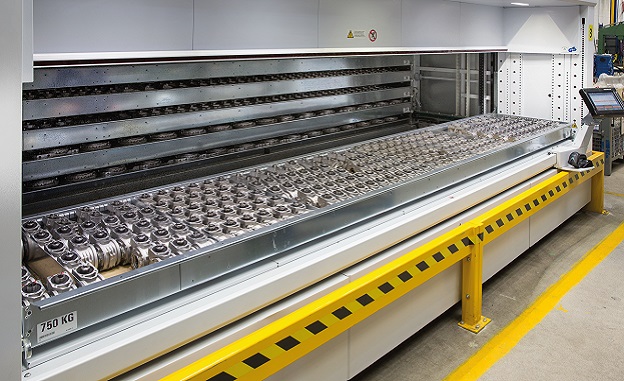
The Modula Lift uses a central automated elevator to retrieve vertically stored trays.
The Modula Lift stores trays vertically and retrieves them through a central automated elevator. Operators select items through a touchscreen interface, and the system delivers the correct tray to an ergonomic access opening.
Inside each tray, adjustable partitions allow for fully customized layouts for various item sizes.
Dynamic tray height detection scans item height and automatically optimizes storage density.
This high degree of flexibility allows the Modula Lift to accommodate items of different shapes, sizes, and weights—from small electronic components to heavy mechanical parts.
As a result, it is widely used in manufacturing, distribution, retail, and healthcare.

3.How the Modula Flexibox Works

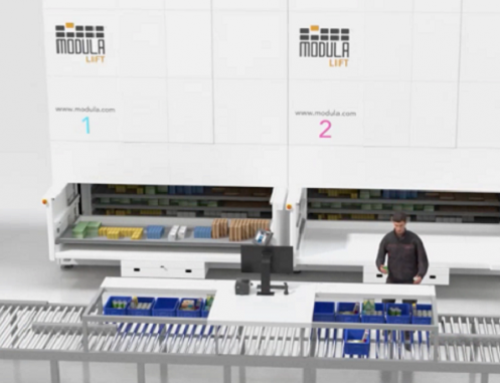
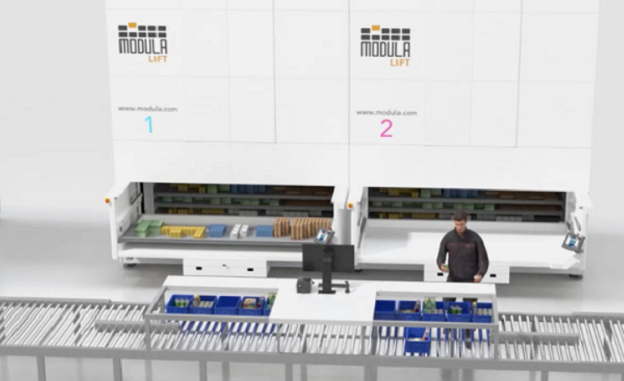
Modula Flexibox: A central elevator retrieves the required bins and delivers them to the operator.
The Modula Flexibox is a high-speed, bin-based VLM configuration designed for small, fast-moving items. It uses standard 600 × 400 mm bins, with up to nine bins per tray. The bins can also be subdivided to house multiple SKUs for higher density.
A central elevator equipped with a telescopic extractor retrieves the required bins and delivers them to the operator.
To increase throughput, the system includes a buffer bay that pre-stages the next tray while the operator is still working on the current one, reducing wait times.
In addition, with Smart Orders Preparation, the system can reorganize trays during idle periods based on order priority, significantly improving picking speed.
Flexibox can also integrate seamlessly with the Modula Lift—ideal for hybrid workflows where small fast-moving items are stored in Flexibox and larger or bulkier items in the Lift.

4.Modula Lift vs. Modula Flexibox: Quick Comparison

5.How to Choose: Modula Lift or Modula Flexibox?
1) Choose Modula Lift if:
Your warehouse handles a wide range of item sizes, significant weight variation, or complex operations.
Modula Lift offers:
- Adjustable tray layouts
- Dynamic tray height detection
- High load capacity
This makes it ideal for manufacturing plants, maintenance facilities, and distribution centers with diverse and mixed inventory.
2) Choose Modula Flexibox if:
Your operations focus on high-frequency, small-item, high-turnover picking. Flexibox is particularly suitable for:
- E-commerce
- Retail
- Medical device distribution
- Spare parts fulfillment
Its high speed, buffer bay, and Smart Orders Preparation make it especially effective in environments with standardized SKUs and high order volumes.
3) Hybrid Solution — Best Practice
If your warehouse handles both:
- Small, fast-moving SKUs
- Large, low-frequency items
A combination of Modula Lift + Flexibox provides:
- High-throughput picking for lightweight small items
- High-density vertical storage for larger goods
This hybrid setup enables a flexible, scalable, and highly efficient automation strategy.

Modula Flexibox vs.Lift: Trays View
6.Integration with Picking Technologies
High-Throughput Batch Picking
Both systems support batch picking and can be paired with:
- Put-to-light systems
- Mobile picking carts
- Picking stations
Flexibox’s standardized bin format is particularly suitable for picking carts and can support more than 20 orders simultaneously, greatly increasing throughput.
Real-Time Coordination with WMS
Both systems connect with Modula WMS or third-party WMS/ERP platforms to support:
- Real-time inventory updates
- Order prioritization
- Optimized picking routes and task scheduling
This enables full operational visibility and enhances workflow efficiency.
Compatibility with Automation Systems
Both can work alongside:
- AMR autonomous mobile robots
- Conveyor systems
- Robotic picking arms
Flexibox’s standardized bin structure makes it especially suitable for robotic applications requiring consistent material positioning.

Both Modula Lift and Modula Flexibox integrate seamlessly with
put-to-light or pick-to-light systems.
7.Conclusion
Modula Lift and Modula Flexibox are not competing technologies—they are complementary.
The Lift is versatile and highly adaptable to mixed inventories, while Flexibox excels in high-speed, small-item picking.
Truly efficient warehouse operations come from selecting the system—or combination of systems—that matches your inventory characteristics, workflow patterns, and order structure.
With the right configuration, your warehouse can operate faster, more accurately, and with greater resilience as your business grows.