In industries like aviation—where entry barriers are high and regulations are stringent—the basis for cooperation is often determined not by how polished a solution looks, but by whether product quality can withstand long-term use and real operational conditions.

Is the process mature?
Is manufacturing controllable?
Are workflows complete?
For these reasons, the first step in many partnerships is not sitting down to negotiate terms, but stepping into the factory to see how products are actually made.

01
Background
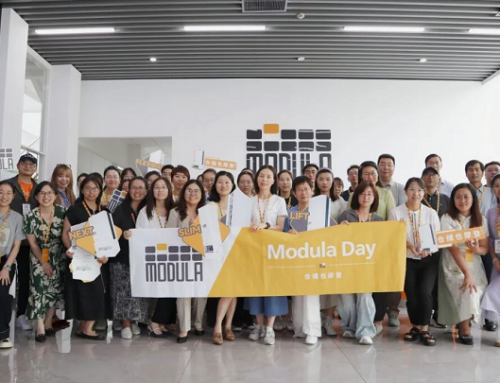
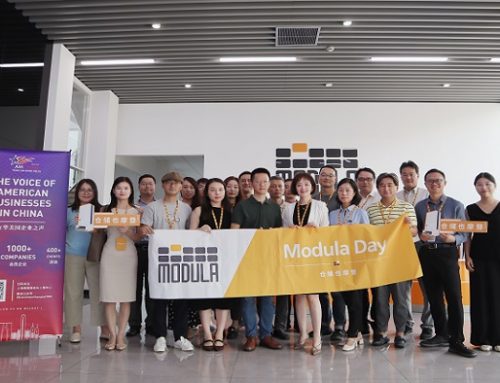
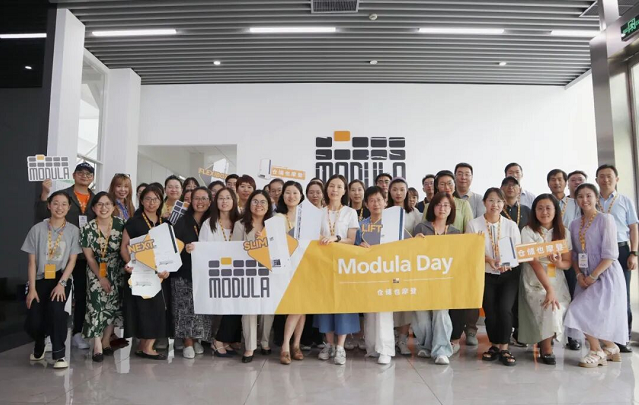
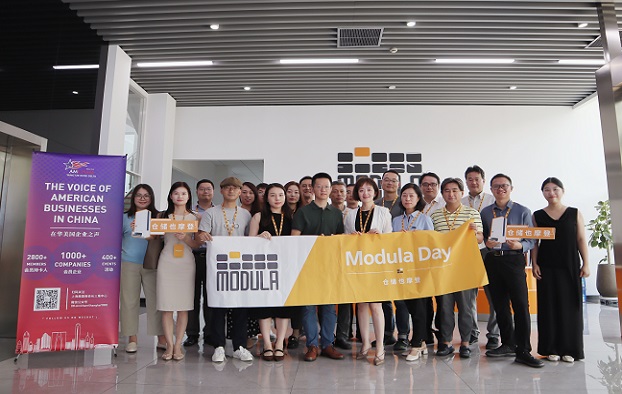
For this Modula Day, the visiting company was Shenzhen Huaxun Aviation Materials Co., Ltd.
Founded in 2001, Huaxun has been deeply engaged in the aviation materials sector for more than 20 years, serving over 3,500 customers to date and building solid operational and service expertise in comprehensive aviation materials supply.
Its business covers aviation fuel, chemical materials, consumables, and related equipment required for aircraft manufacturing, maintenance, and repair. Huaxun is also a key service provider and distributor for several international aviation materials brands in China.

02
Modula Day: All the Answers Are on the Shop Floor
Whether customers or potential partners, before moving to the next stage, everyone needs to consider one question:
Is this a product I can trust for the long term?
The answer must start with manufacturing.

03
Why Does the Aviation Industry Need to Focus on Warehousing?
During the factory tour, two regional sales managers guided the visiting team deep into the production area.
The Huaxun team gained a systematic understanding of Modula’s four core product lines—LIFT, NEXT, FLEXIBOX, and SLIM—covering a wide range of application scenarios, including small parts, high-frequency items, high-value materials, large and oversized goods. This closely reflects the real-world material management needs of the aviation industry.

While reviewing overall product applications, the visit also extended into manufacturing and assembly details, including:
- Tray structure and design logic

- Internal product structure, connections, and assembly

- How the entire production line controls stability and consistency

For the aviation industry, warehousing is not a back-end support function, but a critical component directly involved in material safety, operational compliance, and process reliability.
On this basis, the visiting team also focused on Modula’s AMR robots and automated picking operations inside the factory.

AMR units operate according to predefined routes and task instructions, handling automated material transfers and coordinated operations between workstations, reducing manual handling and repetitive walking.
For aviation applications, this type of automation is not designed with speed as the sole objective, but rather to reduce human intervention and lower operational risk.
04
In High-Barrier Industries, Cooperation Is Never Instant
In the first part of the exchange session, the Modula team introduced the brand’s manufacturing philosophy and methodology through a cultural integration video.
Italian engineering thinking and technical systems, combined with China’s local manufacturing efficiency and quality control capabilities, together form the current manufacturing foundation of Modula.

This integration is not a simple “local replication,” but a long-term refinement under a unified standard—focused on stability, consistency, and deliverability.
In the subsequent presentation, the Modula team further introduced cooperation models, support systems, and management approaches.

05
Closing
This Modula Day was not a simple factory visit, but a close-up exploration by the Huaxun team into Modula’s full manufacturing process, as well as an in-depth exchange between the two teams.

We also welcome more customers and industry partners to join our factory open days—exploring products and discovering Modula in real manufacturing environments.
![[Exhibition Preview] Modula’s New Products Make Their Debut in Shanghai, On-site Experience and Live Broadcast Simultaneously Open – CeMAT 2025](https://www.modula.cn/wp-content/uploads/2025/10/封面-500x383.png)